
World-class eye cancer treatment at the University of Debrecen’s Department of Ophthalmology
The Department of Ophthalmology at the Clinical Centre of the University of Debrecen has been treating eye tumours with radiation therapy for 40 years. To mark the anniversary, an international scientific conference was held in the Main Building’s Aula on October 16.
The conference was organised by the Department of Ophthalmology at the Faculty of Medicine and the Department of Ophthalmology at the Clinical Centre. The event celebrated the use of ruthenium-106 (Ru-106) plaque brachytherapy in Hungary. The procedure was first used in the country in 1986 at the University of Debrecen’s Department of Ophthalmology, which subsequently became a national centre for the treatment of intraocular tumours.
According to Dénes Páll, Vice-Rector for General Affairs at the University of Debrecen, the procedure has contributed to the department’s reputation as one of Hungary’s leading ophthalmology centres.
“The Department of Ophthalmology in Debrecen not only treats common eye diseases but also plays a significant role in managing complex cases that require specialised expertise. In addition to patient care, its important responsibilities include teaching medical students and conducting scientific research,” the vice-rector said in his welcome address.
Bernadett Ujhelyi, Vice-President for Medical Affairs at the Clinical Centre, described the scientific meeting as a celebration of ophthalmology.
“The Department of Ophthalmology and the One-Day Ophthalmology Centre are reliable pillars of the Clinical Centre, providing patients with care that meets European standards,” she noted.
The introduction of ruthenium-106 brachytherapy marked an important milestone in the more than 100-year history of ophthalmic care in Debrecen. Béla Alberth, a former head of the department and one of Hungary’s most highly regarded specialists in corneal transplantation, recognised the potential of the technique.
The treatment represented a major advance in preserving patients’ vision and improving their quality of life. It also helped establish the department as an ophthalmic oncology centre, said Péter Fülöp, Vice-Dean for International Affairs at the Faculty of Medicine. He added that the conference demonstrated how the procedure could foster clinical, educational and research collaborations, benefiting both current patients and future generations of doctors.
Brachytherapy is a form of localised, precision radiation treatment used for cancerous tumours in the eye. In Debrecen, the procedure helps save approximately 80 eyes each year.
“Ru-106 brachytherapy is an eye-preserving treatment that destroys small and medium-sized tumours inside the eye using local radiation. For this purpose, we use an applicator containing a beta-emitting radioactive isotope, which is sutured onto the eyeball. The procedure can preserve the eye while causing the tumour to shrink, allowing patients to avoid surgery that would otherwise require removal of the eye.
“More than 40 years ago, Béla Alberth, the former head of the department, recognised the potential and significance of this brachytherapy treatment. He sent his successor, András Berta, to Germany to learn the surgical technique. Berta subsequently introduced it in Hungary. As a result, the treatment has been continuously available since 1986, and patients with eye tumours travel to Debrecen from across the country,” said Mariann Fodor, head of the department.
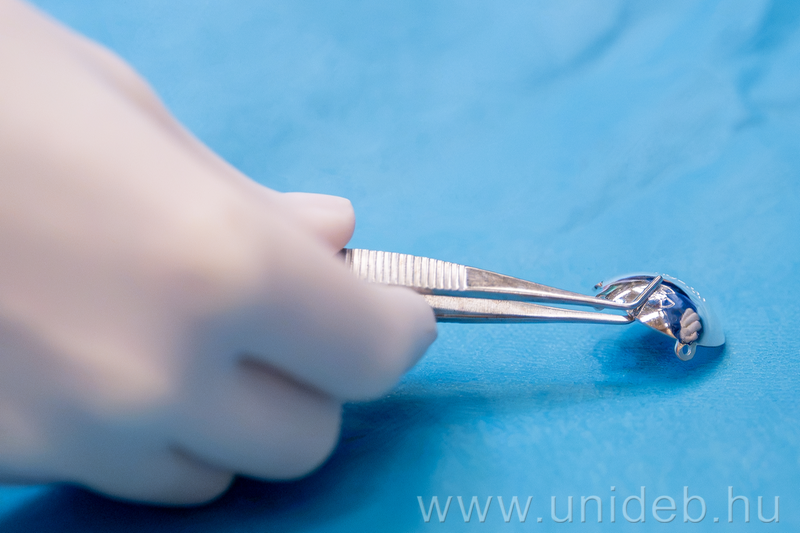
Specialists at the department who treat intraocular tumours further their expertise every year at leading tumour centres in Germany and England. Thanks to continuous professional development and advances in medical technology, Debrecen can now also offer eye-preserving treatment for large tumours measuring more than seven millimetres that cannot be treated with an applicator.
This is achieved through a complex retinal surgery known as endoresection, performed following external radiation therapy. Mariann Fodor learned the technique at the Department of Ophthalmology in Essen, Germany.
“With this procedure, the eye can be saved in approximately half of patients with large tumours, and in many cases, patients retain useful vision,” the department head explained.
At the conference, Hungarian and international specialists presented their findings on intraocular tumours.
Speakers included Nikolaos Bechrakis, a professor at the Department of Ophthalmology in Essen, who helped train the Debrecen specialists in endoresection, and Militadis Fiorenzis, who assisted Mariann Fodor during the first endoresection operation in Debrecen in 2023. Since then, the procedure has saved the eyeballs of a further 42 patients, with 80 per cent retaining useful vision.
Ann Schalenbourg of the Jules-Gonin Eye Hospital in Lausanne presented experience with another treatment technology: proton therapy.
Other speakers included Mariann Fodor and the current and former heads of Debrecen’s specialist outpatient clinic for intraocular tumours: Éva Surányi of the University of Debrecen’s Clinical Centre, Judit Damjanovich of the Újpest Specialist Outpatient Clinic, and Béla Csákány of the Department of Ophthalmology at Semmelweis University’s Clinical Centre.
(unideb.hu)